
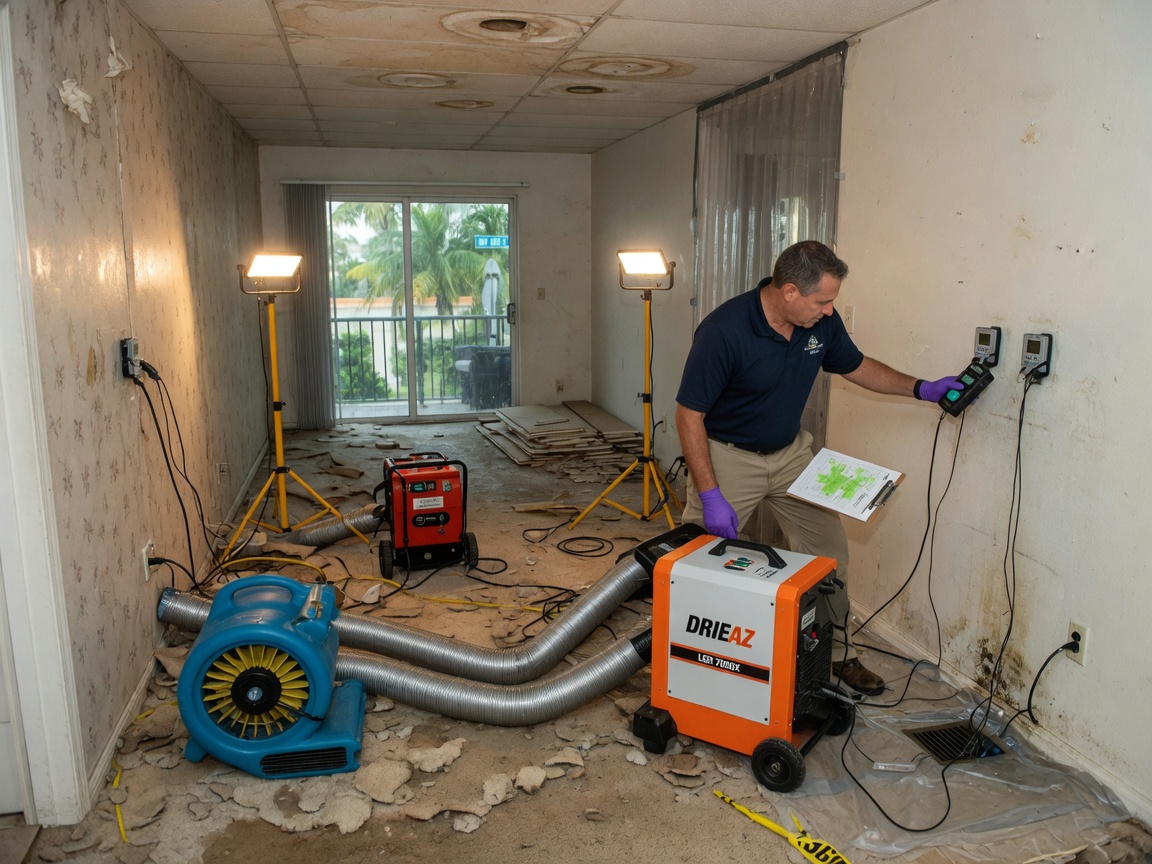
Davie’s mix of 1970s–1990s ranch homes and newer infill builds means many properties have wood-frame walls with fiberglass batts or older plaster over lath that trap water behind baseboards and in sill plates. After extraction, high ambient humidity from summer storms and proximity to the Everglades keeps relative humidity above 70 percent for days, so standard fans alone will not pull moisture from cavities or under tile. Technicians use penetrating and non-penetrating moisture meters plus thermal imaging to map wet zones before placing low-grain dehumidifiers and directed air movers. Without this step, residual moisture often leads to drywall softening or cupping hardwood within a week.
Edge cases common in Broward County include slab-on-grade homes where water migrates under the vapor barrier and concrete slab, and second-story bathrooms where leaks travel down interior walls into first-floor ceilings. In both situations, drying times extend because airflow is restricted and temperatures in unconditioned spaces stay high. Crews sometimes create temporary access ports in baseboards or remove sections of drywall to allow air to reach wet studs. Homeowners who attempt DIY drying with box fans usually miss these hidden pockets and later face mold remediation costs that exceed the original drying job.
Florida building practices require that any structural member exceeding 18 percent moisture content be dried or replaced before finishes are reinstalled. Technicians document daily moisture readings and provide the readings to insurance adjusters to support drying continuation or the need for material removal. Skipping professional drying also risks violating local health department guidelines on visible mold growth after water events.
Technician insight
In Davie the thing that catches most people out with structural drying is how fast moisture travels under tile on slab foundations during the rainy season. You can pull the standing water in an hour but the slab stays wet for days because the vapor barrier and high humidity trap it. Homeowners who turn on their own AC and fans usually end up with mold under the baseboards two weeks later.
Drying a 1987 Davie Ranch After AC Line Leak
Water from a ruptured condensate line soaked carpet and pad in two bedrooms and wicked into the drywall. Meters showed 28 percent moisture at the base plates and under the tile in the adjacent hallway. Crews removed wet carpet, placed cavity wands behind the baseboards, and ran two dehumidifiers for five days until readings dropped below 12 percent. The homeowner avoided mold and kept the original drywall and tile.
Structural Drying Services Services We Offer
✓Wall Cavity Drying
Targeted drying of interior wall cavities using air injection wands and negative air machines to reach insulation and studs without full demolition.
✓Subfloor Moisture Removal
Extraction and drying beneath carpet, tile and hardwood in Davie ranch homes where slab leaks or appliance overflows saturate particleboard or plywood subfloors.
✓Hardwood Floor Drying
Controlled dehumidification and mat systems that pull moisture from tongue-and-groove floors while minimizing cupping and finish damage common in older Davie properties.
✓Ceiling and Attic Drying
Drying of second-story ceilings and attic insulation after roof leaks or bathroom overflows, preventing mold spread into living spaces below.
✓Concrete Slab Drying
Specialized low-grain refrigerant dehumidifiers and floor mats used to pull moisture from beneath tile or vinyl on slab foundations typical in Davie.
Structural Drying Services Cost in Davie, FL
| Service | Typical Range | What Affects It |
|---|---|---|
| Single-room wall and floor drying | $650–$950 | One dehumidifier and two air movers for 2–4 days |
| Whole-home drying after appliance leak | $1,400–$2,200 | Multiple units, daily visits, 4–7 days typical in summer |
| Slab or subfloor drying add-on | $400–$700 | Extra mats and longer runtime on concrete |
| Daily equipment rental extension | $175–$275 per day | Charged only when readings remain above target |
Ranges are typical for Davie, FL and confirmed with an exact written quote before any work starts.
How it works
- 1
Moisture Assessment
Technicians arrive with meters and thermal cameras to locate all wet materials in walls, floors and ceilings.
- 2
Equipment Placement
Low-grain dehumidifiers, air movers and cavity drying tools are positioned based on the moisture map and home layout.
- 3
Daily Monitoring
Readings are taken each day to adjust equipment and confirm moisture levels are dropping below 12 percent.
- 4
Final Verification
Final meter readings and photos are documented before equipment removal and clearance for repairs.
Pricing
Pricing depends on square footage affected, number of rooms, and how many days equipment must run in Davie’s humid climate.